Saturday, August 29, 2015

The final crash of civilization and Mozart

"It is natural enough that when the final crash of our civilization is being constantly and confidently predicted on all hands as imminent, or already begun, people who have a regard for the arts should turn to those amongst the great who can most effectively provide an anodyne."


Now that's a sentence you don't see too often, especially not on the booklet in a music album. After the introduction there follows analysis and musical comment on the piece itself.


It is the opening paragraph of the accompanying analytical notes to a classical album with a Mozart piano concerto. Leaflet neatly tucked in the album inside, record sleeves with handy rivets preventing the disks from sliding into the album back.


His Master's Voice album number 301, Mozart concerto in C minor performed by Edwin Fisher and the London Philharmonic Orchestra and recorded on eight sides, four 12" records, in 1937.


(Still very good to listen to, with or without the surrounding crash of civilization...)

Friday, August 21, 2015

Tuesday, August 11, 2015

Remington Portable bodywork

First step towards a repaint; get all the parts to be painted off the machine. 


It really helps that this is not the first Remington Portable #2 typewriter I've tried to take apart. It means that by now I know what screws to undo and when (having explored all possible wrong options on the other machines first). When you know what to unscrew, it comes apart quite easily.

Important preparation is to put drops of oil on all the bodywork screws and especially on the platen-knob screw. Leaving this to creep in for a couple of days helps to loosen. On this machine it then all came apart without any mishaps. Platen came off readily. Removing the stop-screw from the carriage base of the machine allows the carriage to slide off easily. The one item that had me stumped on the previous attempts jumped out clearly now; remove two pins (nails) at the bottom of the removed carriage and the paper tray drops off.


This leaves the core of the machine exposed for a good cleaning. The mechanism is already surprisingly clean and rust-free, considering the general state the machine was in.

Now to explore how to remove the old paint, almost certainly to be nitro-cellulose lacquer. Will be giving this a try with some acetone...

Saturday, August 8, 2015

Rough emery paper

Hard platens are a long existing issue with typewriters, with solutions being sought.

(From the May '35 issue of Popular Science Monthly)

After all these decades, it may of course not merely be the surface of the roller that hardens.

Not sure this is such a good idea today for very old machines. Come to that; not sure this was such a good idea back then even.

(Rough emery, yikes.)

Wednesday, August 5, 2015

One Summer

One summer: America, 1927. That's when this Remington Portable typewriter was assembled in Ilion, NY. It was made for export with a Portuguese (?) language keyboard and somehow it made its way to Holland.

Eighty-eight years later it was listed for sale online with a single fuzzy image. Just on the off-chance I put in a low offer; it looked like a machine that I wouldn't feel bad about trying a re-paint on. Bit of a surprise when I actually won it. Bit of a shocker when it arrived to see how bad it actually was...


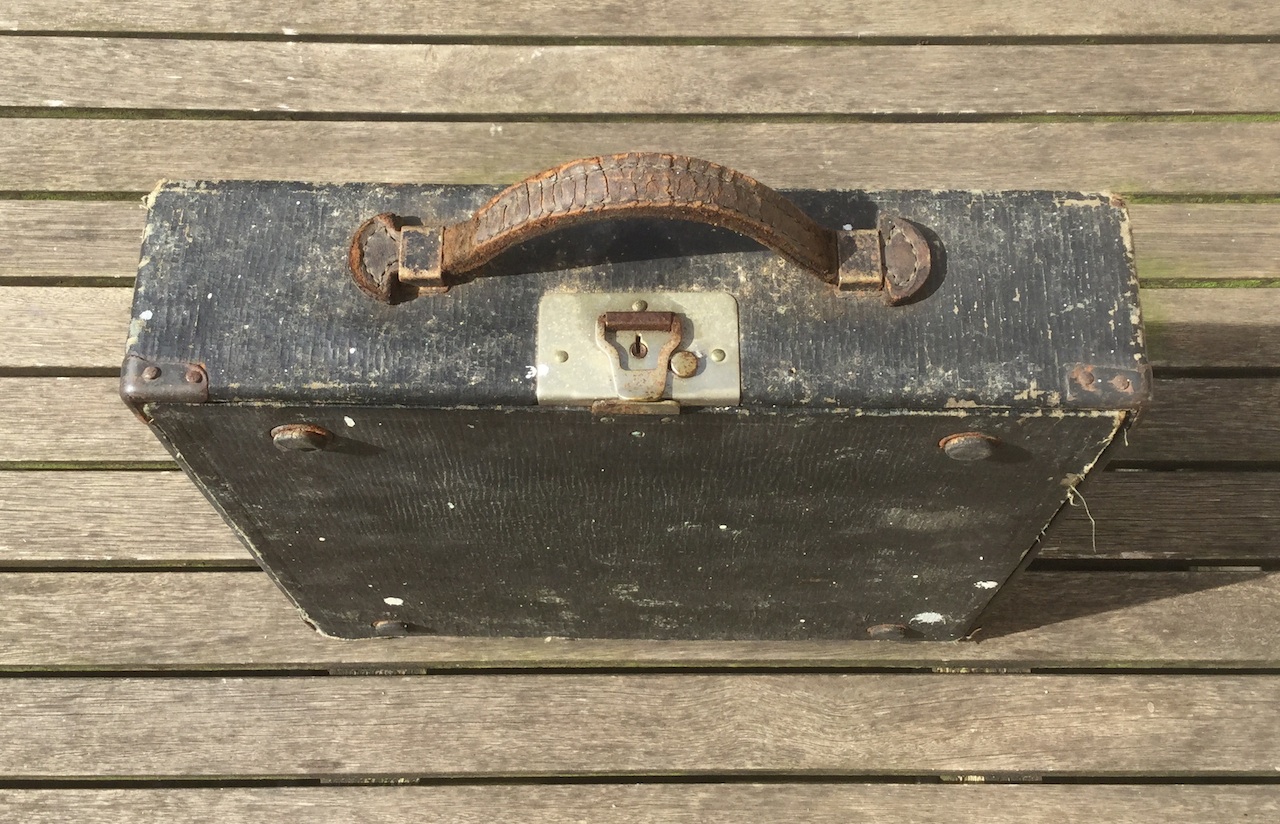
Surprising the case even made it through shipping - it had been covered with cardboard and not in a box as such. A severe case of damp. Much of the plywood has de-laminated, the leatherette is damaged and loose. Amazingly still the intact carrying handle.


It has received some knocks, the back of the lid is smashed in and cracked. The whole carrying case still holds together, mostly from sheer force of habit.

The typewriter itself then. Luckily the case was much worse than the machine itself:


The machine itself indeed as was advertised with some paint loss. The little Remington Portable of the 1920-ies is not a rare machine and in this state I won't feel bad about doing a re-paint. 


Not much left of the decal, rust even on the typeslugs.


The keyboard has some unusual characters. Very unusual for Holland, that is. The seller was not able to shed any light on the machine's origins. Now how do these (probably) Portuguese machines end up in the low countries?


This one has the extra plate at the back to (I guess) protect the mechanism. The feed rollers are all fine. The platen is pitted, dirty and hard - not the original platen though, but marked in green text as a Continental replacement.


Still works! A bit stiff at first, the typebar lifting mechanism was jammed and needed some coaxing up, but the machine still works. A bit of oil on some spots was all it took then. This is another massive credit to the people at Remington who designed and built this amazingly compact and full featured machine. After probably decades of neglect and really bad storage conditions it still functioned pretty much as designed.


It is a 12 cpi machine - surprise. Shouldn't have been surprised really, just hadn't imagined the Portable being made with anything but 10 cpi type.


Types a treat, quite smooth still.

Serial number NV72446, made in the month of July in the Summer of 1927...

Friday, July 31, 2015

Summer break

Something different;  came across this article on how to build a small monoplane.

(from the March '28 issue of Boy's Life)

Curious and it seemed simple, so with some cardboard and a bit of wood something to try.


The small monoplane is easy to build and assemble and actually flies very well. The stick was a bit thin so instead of filing a notch a small length of toothpick was glued in a drilled hole.


Having the rubber band on a launch stick as in the article is actually helpful. Especially for the kids. It is easier to launch and less chance of launching the stick straight onto their thumb (‘Ow!’).

One added modification was to make quarter inch pencil markings on the stick. This makes it easier to experiment with the position of the wings on the stick (and restore after a crash-landing). The positions as drawn by Kenneth S. Gurney actually do work best - he probably experimented a bit as well :-)


Nice one for the summer break!

Friday, July 3, 2015

Before and after pictures (polish and India ink)

Having tinkered a fair bit with the Remington Portable #2 typewriter, had a look at the one image of the original online listing that I saved. On the left 'before' picture of the seller's listing, the 'after' picture now shows the touched-up machine. Still definitely an old and worn machine, but 'cleaner'.


The case had the obvious insect and arachnid droppings of course (i.e. the 'white paint splatter'). These spots can be individually scraped or chiseled off with a sharp tool like a sharp screwdriver. Only then is the black shoe polish applied to revive the Rexine (or Leatherette). This adds some black again and also softens the brittle covering with new wax. If done the other way around, these spots will still be visible.

The front of the frame had some bare spots and rust. These were carefully rubbed smooth, followed by painting black with India ink using a small, soft brush. This gives a deep black and a modest shine that matches the black lacquer reasonably well. (Spools were more badly rusted than was obvious from the listing image, but these were easily sanded and re-painted.) A permanent marker pen can also work, but especially for larger surfaces this can get stripey. Also the black ink (dye) in these pens often have a blue or brown hue, whereas the pigment (soot) of India ink is quite black.

Rust on edge of paper table

Still rust, but now blackened

Rusty patch on the typebar lifting tray

Still rusty, but much less noticeable

Being careful with the worn and corroded decals, some light touching up was done on the wordmark. Doesn't show very well in photo's, but can be seen a bit on the 'o' in portable. Using a gold marker pen a very small amount of new gold ink is put on a work patch. Then using a frayed toothpick this is spread carefully to make flat and match the overall texture of the decal. Again, the decal is still old and worn, but there's a just little bit more of it now.


The machine had much more mechanical tinkering done to it, but just these basic cosmetic items can make a lot of difference to a machine's overall appearance.

(And make it much more acceptable to have around :-)